Air conditioning like it says “conditions” the air. It not only cools it down, but also reduces the humidity. All air conditioners work with the same way whether they are installed in a building, or in a car. The air conditioning in the car reduces the number of kilometers per liter because there is energy used in removing the heat and moisture from the air inside, and this consumes petrol because of the extra engine load.
The air conditioning’s main principles are Evaporation and Condensation, then Compression and Expansion (for engineers and physicists we talk about thermodynamics). Hard tubing and flexible hoses connect all the components of the air conditioning in a car and the above principles are the physics of why it works. There are five main components to the whole system, namely the compressor, condenser, receiver-dryer, expansion valve and the evaporator and the fluid that passes the whole system is the refrigerant.
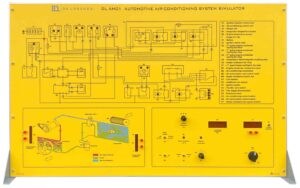
All air conditioning systems work on the same principle, even if the exact components used may vary slightly between car manufacturers. There are two trainers designed by De Lorenzo that can cover this field, one simulator and one demonstrator. The simulation panel is designed to allow the complete learning of the techniques and of the electromechanical and electronic devices usually used for the regulation and control of automotive air conditioning. A fault simulator, for troubleshooting, is provided and it can be interfaced to personal computer through a CAI software.
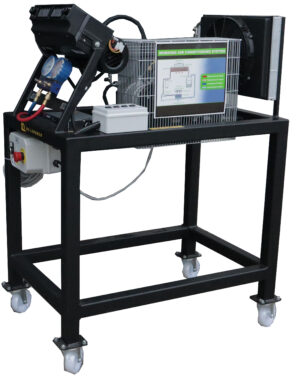
The demonstrator trainer integrates the real main components of a vehicle air conditioning system. It is possible to monitor the compressor’s inlet and outlet pressures and the temperatures of the condenser and of the evaporator. It includes a fault simulation console to perform troubleshooting on compressor, cooling fan and evaporator. They are recommended for professional institutes, vocational schools and technical colleges.